


Hotcoin Research | Predicting the Market Surge: The Rise of the 50-Billion-Dollar Prediction Market and Opportunities Through 2026

Introduction
In 2025, the prediction market sector experienced explosive growth, with total annual trading volume reaching approximately 50.25 billion US dollars, marking a new industry record. As regulatory clarity emerged from the US Commodity Futures Trading Commission (CFTC) and major financial institutions entered the space, prediction markets became one of the most closely watched Web3 verticals heading into 2026.
On December 27, 2025, a high-profile bet on Polymarket that Venezuelan President Nicolás Maduro would step down before January 31 generated returns exceeding ten times the original stake. Although the trade later raised concerns about potential insider information, it significantly increased public awareness of prediction markets and their influence on global narratives.
According to Kalshi’s chief executive, the total addressable market for prediction markets could ultimately reach 150 billion US dollars. With major global events such as the 2026 US midterm elections and the FIFA World Cup approaching, the industry widely expects another major expansion phase.
This report analyzes the structure of prediction markets, their differences from traditional gambling, the drivers behind their rapid growth in 2025, current market data and platform dynamics, and the risks and opportunities shaping the sector’s next phase of development.
Overview of Forecasting Markets
What Are Prediction Markets?
A prediction market is a financial mechanism that aggregates dispersed information through monetary incentives. Participants trade contracts whose prices represent the probability of future events. When many traders with different information and opinions participate, market prices converge toward a collective estimate of the likelihood of an outcome.
Compared with opinion polls or expert forecasts, prediction markets benefit from a strong incentive mechanism. Only correct predictions generate profits, while incorrect ones produce losses. This “skin-in-the-game” model forces participants to evaluate information more carefully and has been shown to produce highly accurate probability estimates. Academic research indicates that prediction markets can achieve Brier scores near 0.09, outperforming most surveys, expert panels, and even some forecasting models.
Prediction Markets vs Gambling
Prediction markets are not gambling. The two differ fundamentally in how they price outcomes, who participates, and what the market produces.
- Price formation differs: Prediction markets use market-driven pricing (such as open order books or automated market makers). Traders set prices through buy and sell activity, and the platform typically charges transaction fees rather than setting odds or taking the other side of the trade. Traditional gambling platforms set fixed odds and rely on a built-in house edge to manage risk and generate profits. Odds adjustments aim to control exposure, not to reflect true probability.
- Functional purpose differs: Prediction market prices act as information signals. Market participants can reference them for macro decision-making, policy expectations, and enterprise risk management, and they can also shape public narratives and decision-making. Gambling odds primarily serve entertainment demand and offer limited value for information discovery.
- Participant structure differs: Prediction markets attract information-driven participants, including researchers, macro traders, data analysts, and institutions. Participants seek to profit from information advantages and price discovery. Gambling tends to attract broader consumer audiences, where entertainment, preference, and emotion play a larger role than forecast accuracy.
In short, prediction markets turn collective judgment into tradable probability signals through financial incentives, producing information with spillover value beyond the platform itself. This distinction also helps explain why regulators in some jurisdictions treat prediction markets as financial derivatives rather than gambling products.
Reasons for Explosive Prediction Market Growth in 2025
The sector’s breakout in 2025 reflected a convergence of timing, regulation, capital, and infrastructure.
- Regulatory breakthrough: The US CFTC clarified the legal status of prediction markets in 2025, recognizing them as legitimate commodity derivatives rather than gambling products.
- Capital and institutional inflows: Compliance progress boosted investor confidence and accelerated financing activity across the sector. Reports indicate that Polymarket and Kalshi completed multiple funding rounds in 2025, with total financing exceeding 1 billion US dollars. Compliance advantages also helped platforms attract professional liquidity support, including major market makers.
- Expansion of event categories: Early prediction markets focused primarily on macro events such as elections. The sector has since expanded into economic indicators, crypto-related topics, and sports. In 2025, frequent breaking news and major global events created sustained trading demand and kept user attention high.
- Maturing technical infrastructure: Scaling improvements and lower transaction costs reduced barriers to participation. On-chain settlement and automated market-making tools improved market efficiency, while stronger wallet experiences, broader fiat access, and wider distribution channels made onboarding easier for new users.
II. Market Structure and Data Performance
- Overall scale and duopoly structure
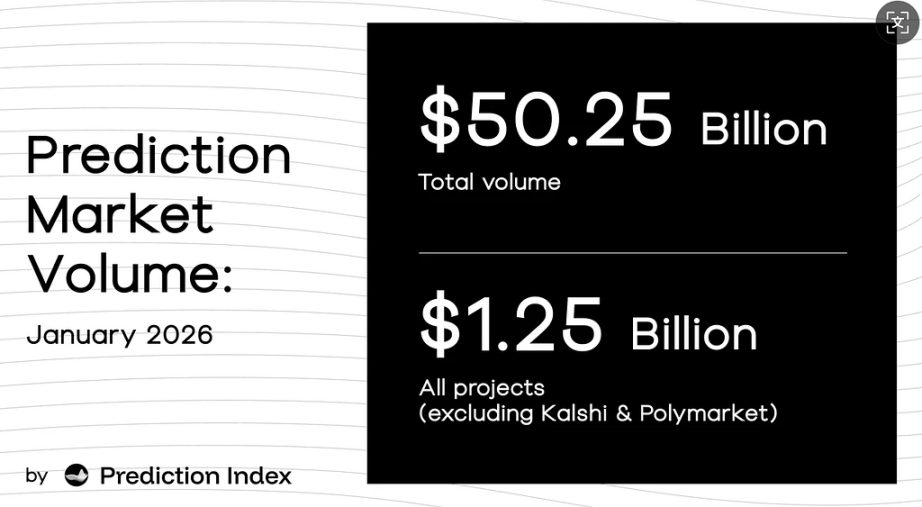
In 2025, the prediction market delivered a strong performance. Total annual trading volume reached approximately 50.25 billion US dollars, compared with about 900 million US dollars in 2024. The user base expanded rapidly, growing from roughly four million users in 2024 to around fifteen million in 2025.
The market evolved into a clear duopoly dominated by Kalshi and Polymarket, which together accounted for more than 90% of total volume. Kalshi recorded approximately 23.8 billion US dollars in 2025 trading volume, while Polymarket generated around 22 billion US dollars.
Source: https://predictionindex.xyz/
Kalshi and Polymarket differ significantly in positioning and operating models. Kalshi, as the first prediction market to obtain a US compliance license, operates more like a traditional regulated exchange, using centralized matching and off-chain settlement. It primarily serves the US market with standardized contracts and is dominated by institutional and professional traders. Polymarket, by contrast, originates from the cryptocurrency ecosystem and operates as a decentralized, permissionless platform using on-chain smart contracts and trustless oracles, allowing users to participate directly through Ethereum wallets.
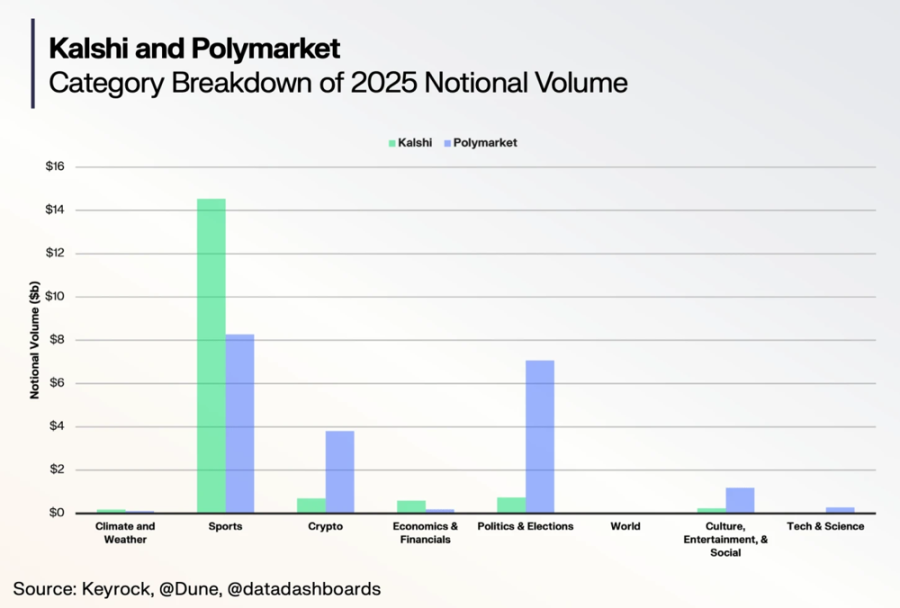
Event distribution also reflects their strategic focus. According to Dune data, Kalshi’s volume in 2025 was heavily concentrated in sports, which accounted for roughly 85% of nominal trading activity. Polymarket’s market portfolio is more diversified, with sports (39%), politics (34%), and cryptocurrency (18%) forming its three primary pillars. Long-tail themes such as economic indicators, technological innovation, and social trends also contributed incremental volume.
Source: https://keyrock.com/prediction-markets-the-next-frontier-of-financial-markets/
- Market heat and capital trends
In the second half of 2025, prediction market activity reached record levels. The total number of transactions across the sector rose to approximately 97 million, representing nearly eighteen times year-on-year growth. Open interest also increased sharply, reflecting rising capital committed to unresolved events.
On Kalshi, unpositioned margin funds reached approximately 225 million US dollars in 2025, representing a 169% year-on-year increase. Capital allocated to economic and social events expanded most rapidly, reaching roughly 800 million US dollars and 700 million US dollars, respectively. This trend indicates that more users are increasingly using prediction markets for hedging and medium- to long-term positioning rather than only short-term speculation.
Investor interest also surged. In 2025, both Polymarket and Kalshi announced major financing rounds. Polymarket’s valuation reportedly rose to the $8–$9 billion range following investment from ICE, and it is expected to pursue further funding. Kalshi raised approximately 300 million US dollars, reaching a post-money valuation of around five billion US dollars. Their investor base includes leading financial institutions, including the parent company of the New York Stock Exchange, Sequoia Capital, and SV Angel. Major crypto companies, including Coinbase, Gemini, Robinhood, and MetaMask, also announced investments or strategic initiatives related to prediction markets.
Meanwhile, the two leading platforms are gradually converging in their technical and regulatory approaches. Kalshi is exploring on-chain tokenized contracts, with pilots already running on Solana, and is introducing non-custodial transactions and on-chain settlement. Polymarket has taken steps to re-enter the US market in a compliant manner. This two-way convergence suggests that the future prediction market may combine the regulatory credibility of traditional finance with the openness and innovation of decentralized networks.
Inventory of Representative Prediction Market Platforms
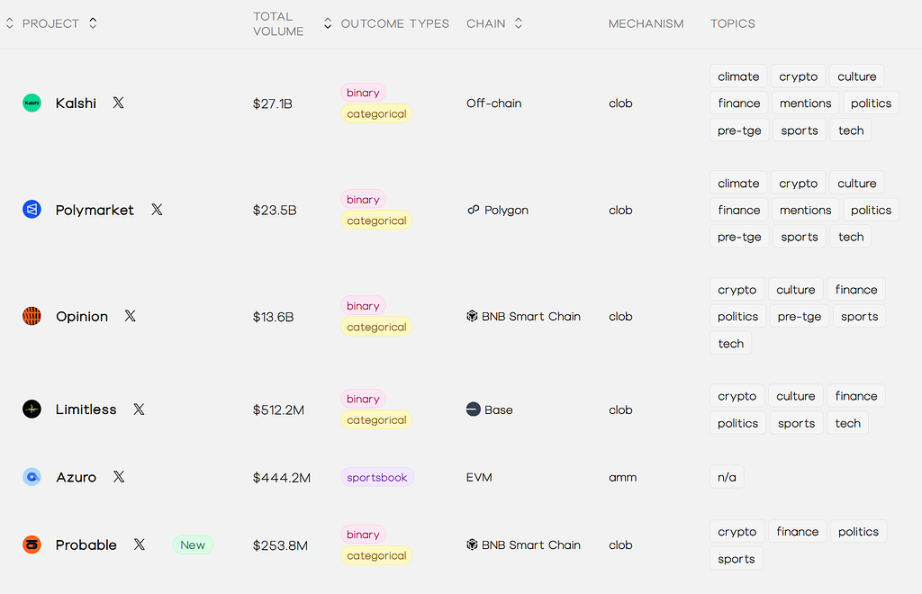
In the current prediction market landscape, alongside the two dominant players Kalshi and Polymarket, a group of emerging platforms is gaining traction. Based on historical trading volume rankings from PredictionIndex, the top platforms include Kalshi, Polymarket, Opinion, Limitless, and Azuro. In addition, the newly incubated project Probable, supported by PancakeSwap, has also attracted growing attention.
Source: https://predictionindex.xyz/
- Kalshi — A Regulated US Prediction Market Exchange
Platform overview
Founded in June 2021, Kalshi is the world’s first prediction market exchange licensed by the US CFTC. Headquartered in the United States, it operates a centralized matching engine with compliant off-chain settlement. Users trade in fiat currencies, primarily the US dollar, using Yes/No binary contracts across categories such as politics, economic data, climate, and sports. With the launch of its sports markets, Kalshi’s trading volume accelerated sharply in the second half of 2025. Annual volume reached approximately 23.8 billion US dollars, representing more than eleven-fold growth year-on-year, while cumulative historical volume exceeded 27 billion US dollars.
Event focus
Sports events dominate Kalshi’s platform, accounting for more than 85% of trading volume. In addition, Kalshi offers contracts on elections, macroeconomic indicators, and cryptocurrency-related events. Beginning in 2025, the platform expanded into new categories, including listed company earnings and financial statement predictions, thereby increasing the practical value of hedging and speculation.
Trading and revenue model
Kalshi uses a central limit order book to match trades and generates revenue through transaction fees that vary by contract type. To strengthen liquidity, Kalshi launched a market-maker subsidy program spanning 2024 to 2025, investing at least nine million US dollars to attract professional liquidity providers, including firms such as SIG. The platform has not issued a token and is funded through equity financing and trading revenue.
- Polymarket — The Leading Decentralized Prediction Market
Platform overview
Launched in 2020, Polymarket is the largest decentralized prediction market operating on Ethereum and Polygon. Users participate via encrypted wallets through a web interface, trading binary and multi-choice event contracts. Polymarket combines a public order book with automated market-making, while settlement occurs fully on-chain using smart contracts and UMA oracles. In 2025, Polymarket recorded approximately 22 billion US dollars in trading volume, with cumulative historical volume reaching around 23.2 billion US dollars and more than 314,000 active users.
Event focus
Polymarket offers one of the most diverse event portfolios in the industry. Sports, politics, and cryptocurrency account for roughly 39% , 34%, and 18% of volume, respectively. The platform is particularly popular in the crypto community, hosting markets such as whether a token will reach a new price high or whether a protocol will deliver a milestone on schedule.
Trading and revenue model
All trades settle on-chain, with Yes and No contract prices always summing to one US dollar. Polymarket initially waived fees to accelerate growth, instead relying on spreads and liquidity incentives. From 2025 onward, it began introducing small fees on winning trades and plans to expand third-party front-end revenue-sharing models.
- Opinion.trade — A Macro-Focused Prediction Platform
Platform overview
Opinion operates on the BNB Chain and focuses on macroeconomic and financial indicators, positioning itself as a gateway for retail users to access macro information markets. The platform integrates on-chain trading infrastructure with AI-assisted oracles and DeFi modules, allowing users to create and trade real-world economic contracts. Opinion’s cumulative trading volume has reached approximately 13.1 billion US dollars, ranking it among the top three prediction platforms globally.
Event focus
Opinion focuses on inflation, employment, interest rates, policy decisions, and financial market trends, while also offering commentary on political and crypto-related markets. Its design aims to lower the cost and complexity of macro investing, enabling retail participation in instruments traditionally reserved for professional investors.
Trading and revenue model
Opinion uses AI-assisted oracles to source and verify outcome data from authoritative providers. Revenue is generated through transaction fees and market-creation fees. PredictionIndex currently categorizes Opinion as a “pre-token generation” platform, indicating potential future token issuance.
- Limitless — High-Frequency Prediction Markets on Base
Platform overview
Limitless is a decentralized prediction platform deployed on Coinbase’s Base network, specializing in high-frequency, short-duration markets. It offers hourly and daily prediction products across cryptocurrencies, equities, commodities, and macro events, expressed in natural language for accessibility. Low transaction fees and fast confirmations on Base enable rapid position adjustments and near real-time price discovery. Limitless’s cumulative trading volume has reached approximately $512 million, ranking it fourth in the sector.
Event focus
Limitless emphasizes short-term price movements and intraday trends, including cryptocurrency closing prices, stock index fluctuations, and macroeconomic releases. It also offers real-time sports prediction markets, allowing continuous trading during live competitions.
Trading and revenue model
Limitless issues collateralized outcome shares on-chain. Users buy Yes or No shares, with winning positions redeemable at one US dollar and losing positions expiring at zero. Liquidity is maintained through a hybrid AMM and order-book model. Revenue is generated from transaction fees and market-making spreads.
- Azuro — Decentralized Prediction Market Infrastructure
Platform overview
Azuro is a decentralized protocol designed to provide infrastructure for prediction markets rather than operating a single consumer-facing platform. It supplies developer tools, liquidity management, and virtual automated market-making to support large-scale prediction applications across Ethereum, Base, BNB Chain, and other EVM networks. Azuro’s processed trading volume is approximately 444 million US dollars, ranking it fifth in the sector.
Event focus
Azuro initially focused on sports betting markets, including football, basketball, and esports, before expanding into politics and cryptocurrency pricing. Its flexible odds and market structure support both simple binary contracts and more complex formats such as scorelines and handicaps.
Trading and revenue model
Azuro uses a virtual AMM and liquidity-tree architecture that allocates pooled liquidity algorithmically across multiple outcomes, ensuring tradability even when direct orders are sparse. The protocol earns revenue from transaction fees and profit sharing with liquidity providers. Azuro has issued a governance token, AZUR, which grants DAO voting rights and a share of protocol fees, though its low market price reflects investor uncertainty about long-term profitability.
Emerging projects
Probable, a new on-chain prediction platform incubated by PancakeSwap and YZi Labs, is expected to launch on BNB Chain with zero transaction fees and a minimalist user experience. Other emerging platforms, including Myriad, Predict, TrendleFi, and Hyperstrike, continue to expand the competitive landscape.
- Other Contestants — Emerging Platforms and the Next Wave of Prediction Markets
In addition, Probable is a newly emerging on-chain prediction market platform incubated by PancakeSwap and YZi Labs. It will launch on BNB Chain with zero transaction fees and a streamlined user experience designed to attract a broad user base. The platform is currently in preparation and is expected to enter public testing soon. Other emerging projects, including Myriad, Predict, TrendleFi, and Hyperstrike, are also gaining traction, further expanding the competitive landscape of prediction markets.
IV. Risks and Challenges Facing the Prediction Market
Despite its rapid expansion, the prediction market remains a young and structurally complex sector that faces several material risks.
- Regulatory and compliance risk
Prediction markets operate in a legal gray area in many jurisdictions. Even in the United States, where Kalshi holds a federal CFTC license, individual states and regulators may still challenge certain contracts under local anti-gambling laws. Regulatory shifts could materially affect platform operations. For decentralized platforms, complying with requirements such as identity verification and event restrictions without undermining trustless design remains a major challenge.
- Insider trading and market manipulation
Because prediction markets are directly tied to real-world events, they are vulnerable to insider information. Participants with access to non-public data can trade ahead of outcomes, distorting prices and undermining market fairness. Large traders may also manipulate probabilities by accumulating positions that influence market perception, potentially shaping both trader behavior and public narratives.
- Liquidity constraints
Prediction markets resemble order-book trading more than typical automated market making, which creates higher liquidity requirements. Without sufficient market-making capital, platforms experience large price swings, thin order books, and poor execution. This leads to a negative feedback loop: low liquidity drives users away, further reducing volume and deepening fragmentation, while large platforms benefit from a reinforcing cycle of scale and liquidity.
- Technical and Oracle risks
On-chain prediction markets face vulnerabilities in smart contracts, oracle manipulation, and settlement disputes. Historically, platforms such as Augur suffered from low participation and inaccurate resolution mechanisms. While newer systems have improved reliability, the use of centralized or manually arbitrated oracles introduces trust risks. High-frequency markets also depend heavily on blockchain performance, making congestion and outages a material operational risk.
- Business model sustainability
Many platforms compete through fee subsidies and aggressive user incentives, prioritizing growth over profitability. While this strategy accelerates adoption, it creates long-term sustainability challenges. Most prediction platforms remain unprofitable, and the industry has yet to establish a durable revenue model that balances liquidity, user experience, and financial viability.
Prediction Market Outlook to 2026: Opportunities and Trends
Despite the challenges facing the sector, prediction markets continue to show strong structural momentum. Looking ahead to 2026, several key trends are expected to shape the industry’s next phase of growth.
- Market scale continues to expand as global events drive trading
The surge in 2025 is likely only the beginning. Prediction market activity is expected to grow multiple times over in 2026, driven by a calendar of high-impact global events. The US midterm elections in November and the FIFA World Cup in the summer will generate sustained trading demand, particularly in political and sports markets. Platforms such as Kalshi have already begun preparing related products, and trading volumes in sports and event-driven contracts are expected to rise sharply. Broader macro factors, including global economic conditions, central-bank policy, and technological breakthroughs, will further contribute to trading momentum.
- Industry consolidation accelerates as leading platforms strengthen their dominance
The sector is likely to become more concentrated, with Kalshi and Polymarket continuing to dominate global liquidity. Their scale, regulatory positioning, and capital resources give them significant competitive advantages. Kalshi is expected to deepen cooperation with traditional financial institutions, including asset managers and securities firms, to launch data products and derivative instruments. Polymarket is likely to pursue deeper integration with Web3 ecosystems, including decentralized social platforms and oracle networks, to strengthen user engagement. Among emerging platforms, Opinion is expected to consolidate its position in macro-focused markets, Limitless to gain share in high-frequency trading, and Probable to benefit from the BNB Chain user base. Nevertheless, most trading volume is likely to remain concentrated among a small number of leading platforms.
- Institutional and cross-sector participation continues to grow
In 2026, prediction markets are expected to attract broader participation from both traditional finance and technology companies. Platforms such as Coinbase and Robinhood have already signaled interest in this space, while hedge funds increasingly use prediction markets for hedging and event-driven trading. Media companies, data providers, and research institutions are also likely to rely more heavily on prediction market data. This cross-sector integration will enhance both the credibility and monetization potential of prediction markets.
- New financial products and derivatives expand the market ecosystem
As the industry matures, prediction markets are expected to spawn a range of new financial instruments. These may include data derivatives based on prediction prices, prediction-based exchange-traded funds, event options, and index products that securitize collective market expectations. In decentralized finance, prediction tokens may be used for collateralized lending, yield aggregation, and structured products. In entertainment and sports, prediction markets may combine with NFTs or fan tokens to create new interactive financial experiences. These innovations will broaden the investor base and expand the total addressable market.
- Artificial intelligence becomes a core layer of prediction market infrastructure
Artificial intelligence will play an increasingly central role in improving the efficiency of prediction markets. AI systems will aggregate news, social sentiment, and real-time data to generate probability estimates and decision-support tools for traders. Machine-learning models will also participate directly in market making and arbitrage, helping prices converge more quickly toward true probabilities. In addition, AI-driven natural-language processing will improve oracle systems by automatically interpreting event outcomes and reducing manual arbitration, making prediction markets more scalable, accurate, and resilient.
Conclusion
From early academic experiments to a global market measured in tens of billions of US dollars, prediction markets have undergone a remarkable transformation in just a few years. The surge in 2025 demonstrated the power of information financialization, showing how collective intelligence, when paired with financial incentives, can generate accurate, real-time forecasts of future events.
When large numbers of participants trade based on their own data, analysis, and expectations, market prices become more than numerical outputs. They form a continuously updated consensus on the probability of future outcomes.
Looking ahead to 2026, with broader participation and stronger capital inflows, prediction markets are poised to enter their next stage of development. Trading future probabilities is likely to become a standard component of global investment portfolios. In this sense, prediction markets are not merely a new frontier within crypto, but an emerging pillar of the modern financial system.
About Us
Hotcoin Research, the core research and investment arm of Hotcoin Exchange, is dedicated to turning professional crypto analysis into actionable strategies. Our three-pillar framework — trend analysis, value discovery, and real-time tracking — combines deep research, multi-angle project evaluation, and continuous market monitoring.
Through our Weekly Insights and In-depth Research Reports, we break down market dynamics and spotlight emerging opportunities. With Hotcoin Selects — our exclusive dual-screening process powered by both AI and human expertise — we help identify high-potential assets while minimizing trial-and-error costs.
We also engage with the community through weekly livestreams, decoding market hot topics and forecasting key trends. Our goal is to empower investors of all levels to navigate cycles with confidence and capture long-term value in Web3.
Risk Disclaimer
The cryptocurrency market is highly volatile, and all investments carry inherent risks. We strongly encourage investors to stay informed, assess risks thoroughly, and follow strict risk management practices to protect their assets.
Connect with Us
Website: https://lite.hotcoingex.cc/r/Hotcoinresearch
Email: labs@hotcoin.com
【免责声明】市场有风险,投资需谨慎。本文不构成投资建议,用户应考虑本文中的任何意见、观点或结论是否符合其特定状况。据此投资,责任自负。