


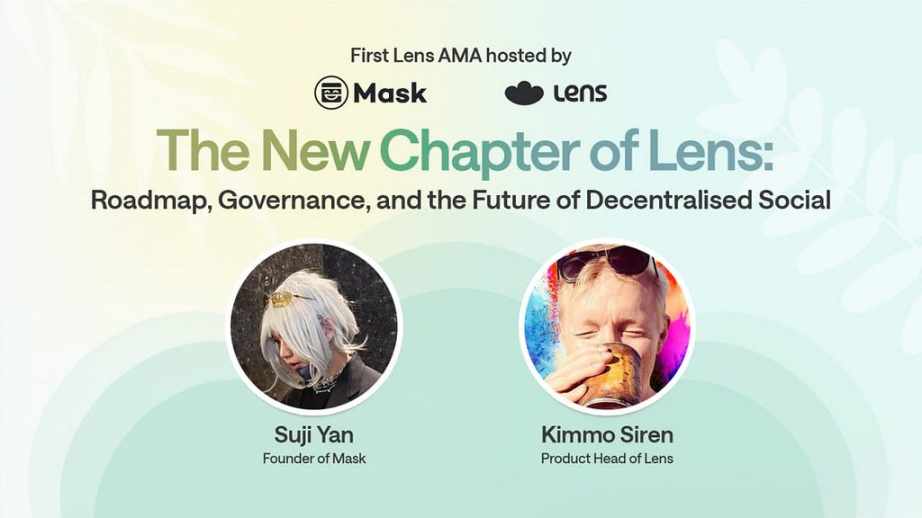
This article recaps the first Lens AMA hosted by Mask Network and Lens on 21 February under its new stewardship, featuring Suji Yan (Founder of Mask) and Kimmo Siren (Product Head of Lens).
Ahead of the session, the team curated questions from the community spanning crypto markets, product design, and technical architecture, alongside broader themes such as decentralised social, long-term sustainability, governance, and organisational structure. The AMA was structured around addressing these concerns directly and providing clarity on the path forward.
Kimmo led the discussion on product strategy, core primitives, and technical direction, while Suji focused on vision-setting and the broader trajectory of decentralised social as an ecosystem.
Suji also referenced a recent AMA with Vitalik Buterin, co-hosted with WuBlockchain, where nearly 90% of the conversation revolved around Lens and decentralised social. Many of the same themes and questions resurfaced in this AMA, underscoring the growing relevance of Lens in shaping the next phase of decentralised social infrastructure.
The Transition: Why Things Were Quiet
One of the first questions addressed the silence of the previous core team.
Suji: There have been questions about why the previous core team was very silent. They hadn’t tweeted for about six months. That happened to coincide with the period when we began the transition process, negotiating legal terms and speaking with other shareholders. As you may remember, there was also the Aave DAO and Aave Labs attack issue. Our conversations began around last October, about five months ago. That explains why the previous team was quiet during that time. They never gave up. It’s just that legally, neither side was able to speak publicly. That’s why things appeared very quiet.
As of now, I would say the transfer is about 99.9% complete. There are still some legacy issues, which are difficult to predict in advance. For example, in the last few days there was an incident related to Lens storage data. That appears to have been related to some domain issues. Neither side anticipated that happening. There are also certain items that may not be fully transferable. However, we have mutual agreements in place with existing partners. For example, the zkSync grant, which includes ongoing reimbursements or fee waivers for the Lens chain. That’s not a direct asset or cash transfer; it’s more of an operational agreement.
Similarly, regarding arrangements with Aave Labs, after the transfer the terms will remain exactly the same. The structure announced in the original PR about the Lens chain two years ago will continue unchanged.
The Roadmap:
Suji: I think, first, we need to fix the existing problems. There are many, many problems that are very obvious to fix. For example, the current login session lasts only seven days. That might make sense for DeFi apps, but no major social app logs users out every week. Sessions typically last months or even years. If you pick up an old phone, Facebook still works, and there’s a reason for that. I think this is an easy fix.
There are also storage limitations that aren’t optimized for large multimedia uploads. That’s because in the past, there weren’t strong storage partners. If you look at decentralised storage, we mostly had IPFS, and Arweave is more about hashing and permanent storage. Now we are in several ongoing discussions with good partners, both centralized and decentralised, around multimedia storage, lowering costs, and improving efficiency, so users can share more content natively on Lens. These are the first things we need to fix. That will definitely improve usability, because no one wants to be logged out every few weeks.
Then the next step is making sure people can log in using different wallets. The design philosophy of Lens is different from others like Nostr, Bluesky, or Farcaster. Lens believes you shouldn’t have to manage another 10 private keys. If you’re active in DeFi or crypto, you’re already managing multiple private keys. Your wallet should serve as your login gateway. One of the most common complaints I’ve heard about Nostr is that users don’t want to manage yet another key system. It’s not even a Bitcoin private key. So it’s good that Lens allows any wallet to connect. The issue is that because Lens Chain exists, some wallets don’t fully support it or don’t realize it’s just an EVM chain.
There are also optimizations needed for Lens login. It might seem small, but it can be painful for users. For example, if someone is using Rainbow, they may not realize they need to take certain steps. Other wallets like OKX or exchange-backed wallets already support Lens Chain, but they lack proper icons or good UI/UX. The goal is simple. Most users probably don’t want to manage assets on Lens Chain. They manage assets on Ethereum L1, Base, BSC, or exchange-backed chains. They just need the private key for login. If we communicate this clearly to wallet providers, we can get broad support, including social graph and DID integration. So when I send money to someone, I can see their Lens identity. It’s actually pretty easy.
We’re also encouraging competition. If wallet partners want to support Farcaster DIDs, for example, linking an EVM address to both Lens and Farcaster identities, that’s fine. We have an SDK from Mask (api.wc.bio) that allows wallets to support multiple social graphs. We don’t mind if wallets support Lens plus three or four other social systems.
Previously, the decentralised social industry operated with a competitive mindset, especially under previous Farcaster management. That delayed wallet integrations. So priority number two is to show that we are open, fix integration problems, and aim for broad wallet support. It’s not just about “log in with our wallet.” It’s also about UI/UX improvements. For example, when you type in an EVM address, you can see whether it’s a mutual friend on Lens, or someone you blocked. You can get warnings before sending money. There are many things you can do, and we want to provide these capabilities to partners. That’s our second priority.
The third priority is growth. We need people to feel that decentralised social is interesting, working, and meaningful. If users have to log in every week, it doesn’t make sense. If their favorite wallet doesn’t support it properly, it doesn’t make sense. After finishing steps one and two, I think crypto-native users, especially Crypto Twitter users and people interested in new things, will find it cool again. They can build interesting things on top of it. There are already good partners and applications showing examples.
We can grow through prediction markets. For example, Polymarket already has comment sections, but they’re not very good. We can improve that. We can create Lens-native comment layers around Polymarket bets. That’s just one example. We also need to revive existing and less active users and do BD with friends and partners.
Another example is the Worldcoin app, which has interesting features. I heard from XMTP contributors that it could be powerful if posting functionality were added. These are examples of things we can explore step by step.
Right now, we’re still in Phase One, fixing obvious issues and making improvements. We’re working with existing Aave team members. At the application level, clients like Warp and Firefly have many optimisations we can now implement since we understand the infrastructure code better. And there are many partners who don’t fully understand decentralised social yet. We can go out and work with them. So basically, the priorities are: fix usability, fix integrations, then drive growth. That’s what we’re focused on.
Kimmo: To add to what Suji said, we just took ownership of everything Lens has built under Aave. Right now, we’re doubling down on understanding how everything works. We don’t plan to make any protocol changes at the moment. All the changes Suji mentioned relate to the Lens backend. The protocol itself is permissionless. If we want to add functionality, we can do it through custom actions. So there are no plans right now to change the smart contracts.
Products and Primitives:
- From your perspective as a new steward, what must exist at the product level for Lens to succeed — regardless of market conditions? What are the non-negotiables?
Kimmo: I think Suji framed this well. We need real use cases. The fundamental question is: Why would you use it? What’s the promise of decentralised social? Right now, nobody has fully figured that out. If we can build really interesting products that truly innovate in the social space, that’s the main non-negotiable for success.
There have been many discussions about what apps to build. We absolutely want to support multiple apps in the ecosystem. Mask already has Firefly and Orb, which are built differently. We hope other builders create new apps and new ideas. You don’t necessarily have to build from scratch. You can build on top of existing apps or create something entirely new. We’ve seen interesting launches recently, like Javi’s email client, which is novel thinking about what’s possible in decentralised social. So great job there. There are also other clients like Fapcaster, basically an OnlyFans-style clone. That’s really cool.
In general, we want to fully support builders. Right now, the biggest audience in decentralised social is developers. If we can build something that attracts real users, that’s a huge win for everyone. Personally, I don’t think we need to compete with Farcaster or any other decentralised social protocol. The goal is to build something new, something 10x better than existing platforms. A “10x Twitter” probably won’t look like Twitter. So how do we build that? I really want to encourage and challenge everyone to think outside the box and implement something truly innovative.
2. Any plans to build a Mini apps system in Lens Orb, similar to Farcaster?
Kimmo: We actually have mini-apps coming to Orb pretty soon. It’s related to the app layer. Both Firefly and Orb use QR-based login flows, allowing users to move across Lens apps without reconnecting wallets repeatedly. You can log in across apps simply by scanning a QR code. Javi’s email client already uses this approach. Soon, we will introduce a mini-app framework and SDKs on top of this infrastructure.
Suji: One thing to add about mini-apps. Many people compare them to Farcaster Frames. The inventor is David Furlong. I’d say inventor because he proposed the Open Frame standard and essentially created most of it single-handedly. He submitted an FIP or some proposal to the Farcaster and Paradigm teams while he was fundraising. To be transparent, Mask venture arm is the largest shareholder in his company (originally Open Frame, now evolving into the Ethereum Comments Protocol). He’s also running some other interesting experiments. From what I understand, Paradigm worked on something similar and created a competing version within Farcaster, which almost killed his business. The old Farcaster management team, I won’t mention names, did some interesting things as well. If you’re interested, you can check his posts. He’s @davidvfurlong. He posts mostly on Twitter and Farcaster, sometimes on Lens. He has written about why Frames didn’t fully succeed on Farcaster.
For us, if we integrate mini-apps, they must be universal. No developer has time to build two or three competing mini-app standards. The previous Lens concept, Open Action, is actually very different from what most people think of as mini-apps. It’s not WebView-based UI/UX. Most people understand mini-apps like WeChat or Telegram mini-apps, WebView-based. That’s closer to what David originally proposed.
We’re going to build this in a very open way. Farcaster mini-apps were never truly open. If you’ve tried building on them, you know. Interestingly, if you look at Worldcoin’s app, they have something called mini-apps, and I believe they forked and improved the Farcaster standard. That’s a better approach, making sure every URL can become a DApp. Mini-apps are naturally the future of DApps. Luckily, we’re friends with the original inventor, so hopefully something cool comes out of that. If you’re interested, check David’s socials. He talks about this a lot.
3. Could the protocol support “lists” to create decentralised music or video playlists in Grove instead of private databases?
Kimmo: Yes. That could easily be built on-chain as an Open Action. You’d store it in decentralised storage and wrap it into an action. It’s not complex, just a smart contract wrapped in an action. Very doable.
4. Are there plans for native DMs or interoperable chat features — inbox, club chats, global channels?
Kimmo: Orb already has DMs, and we’re happy to give access to anyone who wants to integrate them. At the same time, we’re not claiming to reinvent messaging. It would be interesting to revisit XMTP integration. Ideally, we align around something native that clients adopt directly. There are still open questions, like push notifications, how to mark messages as seen in a decentralised way, etc. It’s challenging. But DMs are definitely part of social media, so there will be some proposals around this.
5. Any plans to integrate things like Polymarket or create a lens native version?
Kimmo: Firefly already integrates Polymarket. Many wallets also have or are planning their own prediction market integrations. If it’s a web app or WebView, it’s easy to attach to a Lens account. Anyone could build a Polymarket-style app tied to Lens and use it inside Orb. Definitely interesting.
6. For clubs and groups, can we have proper namespaces (@group/[name]) and unified actions across all clients to ensure consistency?
Kimmo: Orb already runs groups under the hood using namespace contracts. The namespace contract doesn’t require the account itself to be the attachment target. Groups created on Orb already use namespaces. We want to push this further and have a common group namespace across all clients, with API integration.
7. How will Lens improve clubs/groups? Will we have private posts, content warnings, interoperability?
Kimmo: Absolutely. The on-chain primitives are powerful, defining rules for what you can and cannot do. Clubs are a big part of that. Private posts are being explored via decentralised encryption. It’s still early, but more details will come soon. Happy to hear feedback.
Suji: For private posts, without a proper payment integration, it’s meaningless. Sure, we can encrypt posts so only members of a club can see them. But if you’re just posting to 100 people, that’s basically competing with Substack. Vitalik mentioned this in his previous X Space.
If there’s no seamless payment mechanism, it doesn’t work. Users come from different chains. They might have USDT on BSC or USDC on Base. They don’t want to bridge, swap, and figure out new stablecoins just to pay for a post. It has to be one click.
Encrypted posts are technically easy. Mask has done encrypted posts on Twitter for eight years. We can bring it back to Lens. But what’s meaningful is enabling someone on any major chain to pay one dollar and instantly access content. If that experience is smooth enough, then it’s worth bringing back. That’s something we’re working hard on. Developers can also contribute here.
Kimmo: Yeah, it’s still surprisingly hard to connect a wallet and bridge tokens to Lens. We want users to pay from any EVM chain, even Solana in the future. Club interoperability is mostly about app alignment since all groups use the same primitive. With adult content apps emerging, we definitely need stronger content warnings. Some clients already show warnings. Right now, it’s user-based, but maybe in the future it can be protocol-level or app-level.
8. How will integration with Firefly, Orb, and other clients? What’s the logic?
Kimmo: Orb will use more Firefly features, and we hope Firefly and others use features built in Orb. If you see something interesting in either app, ping us. We’re happy to share access and make this as a whole community move forward.
9. During the Lens V2 migration so many data and collectibles were lost, what measures are being taken to avoid such in the future?
Kimmo: Right now, we’re not planning another migration. That’s the main measure. Also, the data wasn’t technically lost, it’s still on Polygon. Some clients just don’t display it, and Lens chose not to mint those NFTs onto the Lens Chain. I understand it’s frustrating if you paid for something, like the car NFT sold in V2 and it’s stuck on Polygon. It’s technically possible to build a burn-and-mint mechanism to move it over.
Personally, though, I think we should focus forward. We’re still day one in decentralised social. Collectibles are interesting, but they’re not the core future. It would be great if someone built a tool where users can see exactly where their data is stored. Many apps have disappeared because they used centralized storage. Users should know what’s on-chain, what’s decentralised, and what’s not. Ideally, everyone uses decentralised storage, but it’s not enforced at the protocol level. That’s where we are for now.
Infrastructure:
- Given that Lens chain is a validium, are there plans to add prividium features?
Kimmo: Right now, no plans.
2. When will we be able to upload private file on Grove?
Kimmo: You can already do that. Javi’s email client encrypts files itself. I think that should be possible already.
3. When will we have this 125 MB limit on Grove be increased?
Kimmo: So I think what Suji mentioned earlier is we’re exploring ecosystem partners for larger file support. Grove is essentially an IPFS wrapper with on-chain permissions. Large files require better client-side streaming and possibly transcoding. Right now, there’s no transcoding. You download the full file before playback. So ecosystem collaboration makes more sense.
4. Can we get public access to the token rewards contract so we can send tokens to app users?
Kimmo: Good question. We need to discuss it internally. Not sure why it was private originally.
5. Are there any plans to tweak the ML model and that scores users?
Kimmo: Yes. The ML model hasn’t been updated in over a year. We want to streamline it and bring it into the same ecosystem as the Lens backend. We can improve it, especially by leveraging data like Web3.bio.
6. Which support tracks are available for app builders?
Kimmo: I think the best support tracks right now until we figure things out is DM Suji or me, mention us, and we’ll help.
Suji: By the way, a funny part is like, I think Mask has probably invested in 80% of decentralised social today. And I’m pretty sure we’ve put more money into the Farcaster ecosystem than Farcaster itself previously.
So if you’re building something cool, don’t worry, we’ll find you. What’s not cool is lack of innovation. Historically, innovation in decentralised social hasn’t been properly appreciated. But it’s extremely important. Maybe your feature won’t become a standalone app. Maybe it can merge with another app. Maybe it can become a standard. If you have something cool, DM us or post it publicly.
Kimmo: Personally, I’d love to move more discussion onto Lens itself. Let’s make this a community discussion. Show your ideas publicly and let’s talk as a community. Many good things happen that way.
7. Are there plans to make the Lens API open source?
Kimmo: The backend is currently in a single repo. We can’t fully open-source it yet because there’s still off-chain infrastructure that isn’t reproducible. First, we need to move more things on-chain or make them reproducible. Then we can open it up. It’s not imminent.
8. Is Lens still sticking with ZkSync or considering L1 options?
Kimmo: I think this was already partially answered. Right now, we are staying on Lens Chain, and we do have a grant relationship with zkSync. At the same time, we want to build in a way that aligns with a multi-chain EVM world. The reason we’re all here is Ethereum. That’s the foundation. So the focus is not really about jumping to L1 versus L2, but about making sure everything works well in the broader Ethereum ecosystem.
9. How will cross-chain features like payments and token gating work? Would these be built natively or via zkSync cross-system liquidity?
Kimmo: That’s an interesting one. zkSync has introduced some new proposals and primitives around cross-chain liquidity. However, implementing those would require us to upgrade the zkSync stack we’re running on. Right now, Lens Chain is essentially an Era-based clone. Supporting those new primitives would likely require a migration or a fairly heavy upgrade process. And migrations are slow and complicated. So at this stage, it probably makes more sense to explore alternative solutions for cross-chain payments and token gating rather than immediately planning another migration just to adopt new zkSync-native features.
10. Will all Orb builds and Mask clients be open source?
Kimmo: Open source is interesting. I’m seriously considering open-sourcing the Orb backend. That should probably be open. Frontend, honestly, I’m not sure. We don’t necessarily need 100 Orb clones that look identical. Also, mobile development, especially Android and iOS deployment, is complex. Not everything makes sense to open source immediately. But if someone can make a strong case for why frontend should be open source, I’m open to being convinced.
Suji: A little bit about open source. On the technical side, Orb frontend is built in Flutter. The web stack is different. For web-based clients, like JavaScript, HTML, open sourcing makes more sense. There’s educational value. Developers can learn from it and build their own variations. Mobile codebases are different. Flutter pipelines, platform integrations, low-level optimizations, they’re not always useful for others unless they’re building the same stack. Also, in the AI era, decoding and architecture styles differ a lot. Not everything translates cleanly.
So I agree. I think Orb Web and Firefly Web will likely be open sourced. Hay was already open sourced, and there are a few other really solid implementations out there as well, I just can’t recall all the names right now. From a technical perspective, there’s already a lot the community can learn from these codebases. That said, if you’re not actually digging into the deeper technical architecture, especially on the mobile side, you won’t see the full picture. Orb and Firefly mobile clients have a lot of complex engineering behind them. In Firefly’s case, because of X integrations and legacy compatibility layers, there’s some very low-level code involved. It’s not trivial. But broadly speaking, anything we think is genuinely useful for the ecosystem, we’re open to open sourcing.
Kimmo: And also, if you have questions, like “how do you implement this?” or “how does this part work?”, just ask. People are genuinely willing to help. Fire up questions, reach out, and we’ll help you move forward.
11. Lens V3 contracts are publicly visible right now, but they’re marked as “unlicensed.” Technically, that means if you build something directly using them, you could be violating the license. Do we have any plans on making the V3 contracts unlicensed? Or like removing the unlicensed part and allowing the developers to build like on top of the V3 contract?
Suji: Yeah, I think that’s probably just legacy Avara stuff. I don’t see it as a fundamental issue. It may just take a few weeks and some internal conversations. In general, we absolutely want developers to build on Lens V3. I expect we’ll move to something like MIT or GPL licensing. The only reason it hasn’t been updated yet might be because of dependencies on other externally licensed components, we just need to make sure everything is consistent.
Kimmo: Exactly. You can already start building today. We just hope you build on Lens rather than fork Lens. What’s the point of forking Lens right now? Let’s build together instead of fragmenting the ecosystem.
Suji: Yeah. And if you’re interested in experimenting, for example, someone mentioned building a fully AI-native social network where only AI talks to AI, we’re open and flexible to that kind of experimentation. We can introduce new labels or metadata layers so that these experimental environments don’t interfere with regular users.
Ecosystem Governance, Incentives & Sustainability
- Do we have plans to launch a $LENS for decentralised protocol and chain governance? Or how do you see governance in general?
Suji: Yeah, I think it’s definitely possible. A standalone token — whatever form it takes — is in the long-term plan. We’re probably going to do it at some point. The question is: is it meaningful right now? I don’t think so.
Right now, 99% of tokens in the market are trading below their last VC round valuation. In Lens’s case, that valuation was around $350 million. If you look at other big projects like MegaETH or Monad, and I’m not blaming anyone, but realistically, most projects doing a TGE today will likely trade below their last private valuation or public sale price.
From a financial perspective, it just doesn’t make sense to tokenize right now.
From a governance and community participation perspective, though, there are non-speculative ways to approach it. For example, maybe governance doesn’t require a transferable token at first. Maybe it could be an SBT. Maybe holding a Lens handle gives you voting weight based on your past behavior. If someone spams a lot, their weight goes to zero. If someone has consistently constructive behavior, based on an open-source scoring algorithm, they get governance weight. So even without a speculative token, users could participate in governance simply by being real users. Later, if we decide to distribute a token, we’ll already have meaningful historical data.
Personally, I think altcoins will have a comeback. I don’t think they’re dead. But macro and political conditions matter. Interest rates aren’t dropping as fast as expected. It may take six months or more.
So if you’re asking about decentralised governance: yes, it will likely happen in a non-speculative way first. If you’re asking about a tradable, pumpable token, that’s probably not coming anytime soon. That’s my feeling.
2. What’s your take on Lens Improvement Proposals (LIPs) ? We had them before, but they never really took off. Would you want to see more of that?
Suji: I think, first, we need a very clear line between what is protocol-level and what is app-level. I think Lens historically did a decent job at this. Farcaster did a very bad job. People constantly debate whether channels are protocol or app-level, and even the team gave different answers at different times. That creates confusion. We should also learn from others. Nostr did a great job. They are controversial, but interesting. Their NIPs (Nostr Implementation Possibilities) approach is interesting. Because of their Bitcoin-first philosophy, they intentionally reject certain extensions while still allowing experimentation. It’s controversial but very clear in methodology.
For Lens, I think we need that same clarity: What is the app level thing, what is the protocol level thing. For example, “Sign in with Lens” might end up competing with “Sign in with Ethereum,” especially in markets where users already rely on large wallets like OKX or other exchange wallets. When people log in with Lens, most of the time they’re just using a private key to sign a message. That overlaps conceptually with “Sign in with Ethereum”, which is now coordinated by Bradley from the EFP/CFO protocols side. In this case, login should primarily be app-level innovation.
If you’re using Orb, Firefly, or any other app, and you just want to post, not do complex token transfers or DeFi actions, you shouldn’t have to pull out your wallet and sign a blind signature. That’s risky and unnecessary. So the right approach may be to define a protocol-level standard for how signatures and posting delegation work. And let different apps implement their own UI/UX on top of that, possibly coordinating through the Lens official channels or community to work with providers like Privy. That’s a good example of clearly separating protocol standards from app-level implementation.
Another important principle is deciding whether something should be built internally at all. Take HIP, the Hyperliquid Improvement Protocol as an example. Hyperliquid operates in the trading business. They compete aggressively in liquidity, and it makes sense for them to build everything end-to-end because liquidity is their core moat.
But social and entertainment are different. In social, sometimes it’s better not to build something yourself if there’s already a strong external solution. For example, as Kimmo mentioned, we’ve been talking with XMTP. There were older experiments combining Lens and XMTP, and they were buggy. But imagine if users could one-click sign for both Lens as well as XMTP and use messaging seamlessly inside the app. That’s powerful. We don’t need to reinvent DMs if there’s already good infrastructure.
So for Lens Improvement Proposals, I think they should be very different from something like HIP. We should be open not only to proposals about what to build, but also proposals about what not to build. If a smart community member, business partner, or developer says, “Please don’t build this, there’s an external partner who does it better,” we should seriously consider that.
So, first, we clearly define the boundary between app-level and protocol-level. This avoids confusion like what happened with Farcaster’s channel debates. Second, LIPs (or similar processes) should sometimes be about restraint, deciding what to give up or delegate externally. We want to be very open to that kind of proposal.
Kimmo: Yeah, 100%. Lens was previously built end-to-end. We want to bring it back to being a protocol. If you want to build a streaming service, that’s not protocol-level. That’s a client or business layer. So propose things that align with your interests and potential business models.
3. How do we bring in content creators? What’s the incentive model and GTM strategy?
Suji: I think one of the core problems is that most social network builders are not actually friends with serious content creators. And by “serious,” I mean people who have made content creation their career. I’m not sure about Bluesky, but I’m quite certain that most Farcaster builders are not really friends with these groups. You can see this in how they design protocols. That’s fine if you are only building a protocol. But if you are also building applications, then it becomes a very difficult story.
For example, I don’t think Dan and Varun at Farcaster are close to adult content creators. Even though Los Angeles is famous for its adult creator ecosystem, there hasn’t really been strong social integration there. Similarly, I don’t think Zora has really spent enough time talking directly with these communities. And honestly, this is not rocket science. And I’m very open to saying that I personally am friends with several well-known adult content creators. For example, Hong Kong Doll, who is one of the top-selling Asian adult creators and reportedly made around $20–30 million during COVID. I also know smaller creators from places like Los Angeles and Japan. In Japan, I was an advisor to DMM, which is one of the largest Japanese adult content producers. They also produce indie games. But this applies beyond adult content. There are also non-adult content creators, like writers on Substack who produce serious long-form content and can make around $100k per year just by writing articles.
So first, you have to really know these people. I’m pretty sure that, aside from maybe Bluesky, most other social platforms have failed at this level, they don’t really build real friendships or relationships with these creators.
Second, you have to clearly separate what should be solved at the protocol level versus the product level. There are some values you should never sacrifice at the protocol level, even if it makes content creators’ lives slightly harder. You have to add value somewhere. For example, if you value decentralization and permanent records, your content creator friends will come to you and say: “Hey, there is someone pirating my stuff.” Whether it’s paid articles or paid porn videos, people may download and re-upload content for free, which is basically piracy.
In the Web2 world, this is solved using DMCA. You just send a DMCA request and the content disappears, because every big company has legal teams and outsourced operational staff to handle DMCA reports. In Web3, unfortunately, if you really believe in decentralization and DIDs, you can’t just delete the content at the protocol level. The only realistic solution is labeling. You tag something as “DMCA-violating” and choose not to display it on the frontend. That’s it
For example, in Mask’s ecosystem, we have an open-source project called Web3.bio. You can search someone’s profile and see all their linked identities across Lens, Farcaster, Ethereum, Solana, Bitcoin, Keybase, Reddit, Twitter, GitHub, LinkedIn, Instagram, all in one place.We did receive DMCA requests. Not many, but frequently enough to notice patterns. These were especially common in adult content and long-form content creators’ work, where people download and re-upload content across networks, not even necessarily on Lens or Farcaster, but elsewhere. The only practical solution is to add a DMCA violation tag and blur the content on the frontend. We can also add a button that says: “if you really want to check what is going on, you can go check on Etherscan.” But we don’t delete it from the chain.
We plan to introduce something similar on Lens. And I don’t think many other players have seriously considered this problem. So again, step one is having real-world relationships with content creators. Since the transition started, and even before that, I started talking frequently with creators like Hong Kong Doll and other famous adult creators just to understand what is going on. Technically, there is no barrier for them to enter Lens. For example, she has 1.3 million followers on her crypto-focused Twitter account, and her main account has 4 million followers. That’s more users than Farcaster and Lens combined. So the real question is why they are not joining.
There are also many journalists. I was a journalist, so I know a lot of journalists who make a living on Substack. A friend known as “Social Forensic”, who runs a popular Twitter account and a Farcaster account, has deep relationships with journalists too. His personal Twitter account was banned at some point, but he’s still well connected. When I asked them why they are not on decentralised social platforms, the answer was often: “We are already on decentralised social. We are on Bluesky.” Why? Because major institutions like BBC-style media organisations are present there. Journalists are also pro Signal. Many of them don’t even use Telegram. They mostly use Signal and run their own domain-based systems. On Substack, payment is a good way for their side income. On Bluesky, they can verify their own domain and use Signal-related communication for whistleblower or security-related work. Social Forensic also tried to bring these people onto Farcaster, but the Farcaster team was not very helpful. So I think that’s something we need to figure out.
Again, the key is to build friendships with them, and secondly, to learn from past mistakes. I’m very confident about onboarding content creators, including those who write product-focused or long-form serious content, often considered journalists, into our products. I believe we can successfully onboard them onto Lens; we just need to build the features they want. For creators in the adult content space, such as those on OnlyFans, this is more of a long-term process. But I’m personally happy that I have friendships with many of them and at least understand what’s going on, especially why they are not adopting crypto. Interestingly, many of them actually understand crypto very well. They often gamble on exchanges, but for some reason, they don’t hold or use crypto for their work. If we don’t solve this, it will be a major problem.
So again, I think we are in a learning process from past mistakes. People do want decentralised social platforms and want to onboard, but platforms like Farcaster and earlier versions of Lens were not able to handle some of their requests. We are learning from these failures. Then there are users who are currently hesitant about decentralised social in general. For example, creators who are extremely concerned about content piracy. For them, we need to address DMCA verification. There’s nothing protocol-level required here, but I think we can add a DMCA validation tag in future updates. On the frontend, users can verify whether a DMCA request is legitimate, or decide to trust it and hide the content. Alternatively, they can choose to go to Hay or another open-source client.
I think these three steps are the best approach. Otherwise, serious content creators will not stay here. The only users who will remain are those who care about random meme coins. Also, there is basically no meaningful data showing meme coins supporting real creator monetisation. I checked data from Zora and Base, excluding rug pulls, there is no single serious content creator who has been able to earn over half a million from any meme coin or content coin. This doesn’t make sense. Even in the journalism world, there are less wealthy writers, but there are also highly successful ones. They can publish books and receive $300,000 advances from publishers. No meme coin or content coin ecosystem has achieved that level of creator monetization.
I think that’s a failure for Zora. They also don’t have strong community relationships with creators. If you want to work with adult content creators, they are getting paid very well elsewhere, if you don’t build relationships with them and understand their needs, there’s little chance of success. So my conclusion is: fix the easy parts first, onboard relatively smaller or underserved content creators, and solve the more difficult problems later.
4. What’s your take on like a reward? Lens previously did weekly goal rewards, and Farcaster did something similar. Now there are basically no rewards anywhere. Are we bringing them back? And what’s your general view?
Suji: I think we can bring rewards back, but in a very interesting way. Not direct money. And I’m not talking about points either. Points just become another farming mechanism. Instead, I think we can design something more interesting, like coupons.
The core problem with rewards is that you will have very professional groups gamble against you. They will do the math. For example: “If there’s a TGE in one or two years, and it’s a bearish market with fewer projects to farm, and Lens is still alive, then we can farm it for the next few years.” We’ve seen this in the last cycle.
This is why it’s important to understand how the real world actually functions. I think the problem with many protocol builders, especially Farcaster, though I would exclude Bluesky from this specific point, is that they don’t fully understand how these farming networks operate. I personally know two of the largest Farcaster accounts. One is a Vietnamese operator based in Ho Chi Minh City. Another is a South Korean operator who travels frequently and probably has legal issues with multiple governments. On Bluesky, there are also trolling groups. Some are supported by certain American Republican communities, and they troll Bluesky from a political angle. I happen to know some of these people. When I asked them why, they said, “We’re just trolling for fun,” or, “Maybe there will be an airdrop.” They are willing to invest money into this. They hire teams, often in Vietnam or elsewhere, to run coordinated airdrop farming operations. They use advanced LLM tools, sometimes even more effectively than we do. They constantly experiment with new models, for example, saying things like, “This new DeepSeek model is good,” or “This new Gemini model works really well.” Some of them even use stolen credit cards to open accounts and generate artificial engagement at scale. As long as you offer real monetary rewards, they will exploit the system. They are extremely professional and operate at a very high level. In many cases, they execute better than protocol teams themselves. Some even have strong regional connections in Southeast Asia. This is how the real world works. And I think the problem is that many protocol builders simply do not understand this reality.
That’s why giving coupons is fundamentally different. It changes the game entirely. These professional farming groups probably would not want to play. Let me give a concrete example. Before Firefly’s transition last year, during Token2049 in Singapore, we partnered with Haidilao, one of the largest hotpot chains in Asia, with nearly a thousand locations globally, including the US and Europe. I was able to coordinate with the younger son of the founder and propose that we distribute dining coupons to people attending in Singapore. If you’ve been to Singapore, you know that after 2 a.m., your options are very limited, mostly street food, karaoke bars, or Haidilao. If you want proper food at that hour, hotpot is one of the few reliable options. The campaign worked very well. We spent around 100,000 Singapore dollars. And we’re confident the users were real. You’re not going to fly a group of Vietnamese farmers into Singapore just to redeem $100 hotpot coupons. The math doesn’t work for them. That’s the type of calculation you need to do. I’m not saying I have a perfect solution for stopping all scams. But the hotpot example worked in the specific context of Token2049 Singapore because it ensured that rewards went to real participants engaging in real-world activity.
The broader issue in crypto over the past few years is this: First, many founders have no idea how the real world operates. They don’t realize that there are professional groups in Southeast Asia who do this full-time for a living. Second, some founders do understand, but they choose to ignore it. They say, “We have one million users,” because it helps with exchange listings and optics.
We don’t want to do that. So we will bring incentives back, but in a way that makes it difficult for professional farmers to exploit the system, while rewarding genuine users. It may require more complex calculations. Maybe it’s a hotpot in Singapore. Maybe it’s Starbucks coupons for people who regularly buy coffee. Maybe it’s Nintendo vouchers for gamers in Japan or Korea. This isn’t rocket science. It just requires acknowledging how the real world works. Too many crypto founders either ignore that reality or pretend farmed users are real users. We’re not going to play that game.
5. What’s your take on gas sponsorship and grants as incentives for builders? At the moment, we’re covering all gas fees through the Lens API. How do you see that evolving?
Suji: We’ll continue doing that as long as it’s not abused. As I mentioned earlier, people will soon realize that it’s much cheaper to build or operate on Lens than to do the same thing on Twitter, and on Facebook, you simply can’t do many of these things at all. AI developers in particular will figure this out very quickly.
If you compare us to other decentralised social platforms, there are clear differences. For example, with Farcaster, private key pairs were not treated as a first-class experience. About a year ago, if you generated your own key pairs, you couldn’t even log into the Warpcast app. It was very cloud-centric in practice. With Bluesky, they use their own domain-based identity system. It’s quite complicated. Instead of simply generating key pairs, you need to create a domain, configure DNS, and manage additional setup. For developers and AI builders, that’s a significant burden.
Lens, from a technical philosophy standpoint, especially coming from the Aave team, has strong ambitions. Execution hasn’t always been perfect, but that’s something we can improve. We should avoid adding unnecessary complexity. Much of it just needs clearer explanation and refinement. That also relates to gas sponsorship. We’ll continue to sponsor transactions as long as users are not spamming the network.
Builders Over Hype
- If you’re a builder or user who’s been skeptical or checked out for a while, why is this the moment to start paying attention again?
Suji: Actually, Vitalik answered this question during our last X Space together. I’ll start by quoting what he said. First, the technology is much more powerful and much more ready now. Take blockchain infrastructure. For example, when Lens first launched on Polygon, I haven’t done the exact math, but I’m pretty sure an enormous amount of gas was spent, or let’s say wasted, on Polygon. They didn’t even sponsor many of those spammy transactions because there was no effective way to manage them. There was a period, around 2022, when it was actually easier for LLMs to generate trash content than for systems to identify and filter it. That led to a lot of wasted money.
At the same time, Lens was competing for block space with highly profitable transactional applications like Polymarket, which is also on Polygon. If Lens remained on Polygon, it would continue competing for block space with these financially intensive use cases. There was also a Pokémon-style gacha application called Courtyard. So you were competing directly with strong financial use cases, which made it very difficult. Now, block space is much cheaper.
One example Vitalik gave was about Ethereum Layer 1. He said that Layer 1 blocks could theoretically store the daily text output of Twitter, not the raw text itself, but in hashed form. In other words, it may actually be possible to store something as large as Twitter’s daily content on Ethereum in some structured way. It’s doable, we can do the math. And Ethereum plans to scale even further. If you include other chains as well, it becomes even more feasible. That’s a huge difference compared to before.
Second, around 2022, people may still have had the illusion that large Web2 social platforms would become more open. At the time, Reddit was debating API improvements, and Twitter had just been acquired by Elon. It felt like maybe some problems would be fixed. But over the past three years, AI has advanced significantly. As AI becomes more powerful, data becomes more guarded. Paul mentioned something interesting — I see him in the audience. He pointed out that it can actually be cheaper to pay gas fees to post on a Lens channel than to post permissionlessly on Twitter. If you are an AI agent, posting on Twitter can cost close to one cent per post, maybe even more. And the more you post, the more they charge you. That has become a new business model for social media.
In the past, this would have been unimaginable. We lived in a free premium model for so long that we assumed posting and registering an account should always be free. But now it’s different. From a good developer’s perspective, AI API tokens can cost significantly more than Web3 gas fees. And those AI costs are not decreasing as quickly as Ethereum gas fees. I think this is going to be the case for at least the next 10 years because the economic model is fundamentally different. At some point, developers may start thinking: I still want to use AI, but I should decentralize more of my stack to reduce platform access costs whether that’s posting, reading, or basic interactions.
One thing we plan to do is allow users to replicate and narrow their social graph on Lens by writing structured JSON data on the Lens chain. We can migrate their Twitter following relationships in a GDPR-compliant way. Again, no one else is really doing this properly.
So to summarise: First, it’s much cheaper now. Second, Web2 is becoming more expensive and less open. There’s also a third path, decentralised, but without touching crypto, such as Bluesky or Mastodon. By the way, our Mask Foundation is one of the largest donors to Mastodon. But this middle path is in a strange position. It has become less culturally exciting. It’s “decentralised,” but it’s not cool. So, from a developer perspective, if I were building today, whether as an indie developer or a small studio, I would seriously consider coming back to Lens.
There are also additional factors we didn’t anticipate. As I mentioned earlier, I spoke with Hong Kong Doll, the well-known Asian creator, and she gave me further reasons why now is a good time to revisit decentralised social. Everyone may have a different answer. But from my perspective, this is definitely a good time.
2. From your perspective, looking ahead, what kinds of applications or experiments would you like to see built?
Suji: The email-based use case is interesting. But I’m not sure how many people still use traditional email in the same way. I still use email, but now I use AI-assisted email, it’s a very different experience.
What I think will be extremely powerful is combining pay-to-unlock mechanics with the creator economy and direct messaging. For example, I could require payment to access certain content or even to send me a DM. If you’re not a mutual connection, maybe you pay $5 to message me.
For this to work, the user experience has to be seamless. Previous attempts at similar models were often buggy or poorly executed. If done well, this could be transformative.
Builders can also use Lens simply as backend infrastructure. It doesn’t have to be the full front-end product. For example, Lens can function as a social graph verification layer. It may not sound flashy, but it’s incredibly useful, especially for finance apps, trading platforms, or copy-trading tools.
In Firefly, this kind of social graph verification is already widely used, particularly for friend-based trading features.
【免责声明】市场有风险,投资需谨慎。本文不构成投资建议,用户应考虑本文中的任何意见、观点或结论是否符合其特定状况。据此投资,责任自负。